High Risk Merchant Accounts in the USA: Why Businesses Are Switching to Pay-by-Bank (ACH Payments)

Many US businesses struggle to stay fully operational with traditional payment processors like Stripe, PayPal, or standard acquiring banks.

If your business operates in a high-risk industry, you’ve likely faced:

  • Sudden account freezes or shutdowns
  • High chargeback ratios
  • Payment declines from US banks
  • Rolling reserves holding your cash flow
  • Difficulty scaling payments internationally

This is especially common in industries like forex, crypto, CBD, adult services, SaaS subscriptions, and high-ticket coaching.

Because of these challenges, more US merchants are now adopting a more stable alternative:
👉 Pay-by-Bank (ACH payments) apply


What Is a High Risk Merchant Account in the USA?

A high-risk merchant account in the United States is a payment processing setup designed for businesses that traditional banks consider risky due to:

  • High chargeback potential
  • Regulatory sensitivity
  • Large transaction volumes
  • Cross-border or subscription-based billing

Common US High-Risk Industries:

  • Forex trading platforms (US-facing or offshore onboarding US clients)
  • Cryptocurrency exchanges and brokers
  • CBD and hemp product businesses
  • Adult content platforms and subscription sites
  • Credit repair companies
  • Debt relief services
  • High-ticket coaching & online education programs
  • Subscription SaaS with recurring billing

These businesses often experience restricted access to mainstream card processors.


Why Credit Card Processing Fails for High-Risk US Businesses

Even in the United States, card processing is not built for high-risk models.

1. High Chargeback Exposure

US consumers can dispute card transactions easily, creating financial risk for processors.

2. Processor Shutdown Risk

Stripe, PayPal, and similar providers frequently terminate accounts in restricted industries.

3. Rolling Reserves

Many high-risk merchants are forced to keep 5%–20% of revenue frozen for months.

4. Low Approval Rates

Banks often decline transactions linked to:

  • Crypto activity
  • Forex deposits
  • Subscription spikes
  • International card usage

What Is Pay-by-Bank (ACH Payments)?

Pay-by-Bank in the USA refers to ACH (Automated Clearing House) payments, where funds move directly between bank accounts without using credit or debit cards.

Instead of relying on Visa or Mastercard networks, ACH payments go through the US banking system.

Types of US Bank Payments:

  • ACH Debit (customer pays you directly)
  • ACH Credit (you push payments)
  • Same-day ACH transfers
  • Bank-to-bank transfers via open banking providers

Why US High-Risk Businesses Are Switching to ACH

1. Higher Payment Approval Rates

ACH transactions are less likely to be declined compared to credit cards.

2. Lower Chargeback Risk

ACH payments are significantly harder to reverse than card payments, reducing fraud exposure.

3. Lower Processing Fees

US businesses save significantly compared to 2.9%–5% card processing fees.

4. Better for Large Transactions

Ideal for:

  • Forex deposits ($1,000 – $50,000+)
  • SaaS enterprise billing
  • Investment platforms
  • B2B payments

5. More Stable Banking Relationships

ACH reduces dependency on card processors that frequently shut down high-risk accounts.


Industries in the USA That Benefit Most from Pay-by-Bank

Forex & Trading Platforms

Reliable funding for US-based or US-targeted traders.

Crypto Exchanges & Brokers

Reduces dependency on restricted card processors.

CBD & Hemp Businesses

Avoids constant merchant account closures.

SaaS Companies

Reduces failed recurring payments from expired cards.

Subscription & Membership Platforms

Improves payment retention rates.

Credit Repair & Debt Services

Provides stable recurring billing infrastructure.


Pay-by-Bank vs Credit Card Processing in the US

FeatureCredit CardsPay-by-Bank (ACH)
Approval rateMedium / LowHigh
ChargebacksHighLow
Processing fees2.9%–5%Much lower
Account shutdown riskHighLow
Best for large paymentsNoYes
StabilityUnstableStable

Why the US Market Is Moving Toward ACH Payments

The shift is happening because:

  • US banks are tightening high-risk card approvals
  • Stripe/PayPal enforcement is increasing
  • Subscription businesses need better retention tools
  • Cross-border US businesses face higher decline rates
  • Businesses want lower transaction costs

👉 Result: ACH is becoming the default fallback for high-risk US merchants


How Paygen Supports US High-Risk Merchants

Paygen helps US businesses that struggle with traditional payment processors by providing:

  • High-risk merchant account solutions
  • ACH / pay-by-bank payment infrastructure
  • Alternative processing routes when cards fail
  • Reduced chargeback exposure systems
  • Scalable payment setups for US-based operations

We work with industries that traditional processors often reject.


Final Thoughts

For US high-risk businesses, relying solely on credit card processors is no longer sustainable.

The market is clearly shifting toward:

Bank-based payments (ACH) + hybrid payment systems

Businesses that adopt this early gain:

  • More stable revenue
  • Fewer shutdown risks
  • Lower transaction costs
  • Better approval rates

Apply

Why Card-Alternative Payments Are Beating Traditional Cards

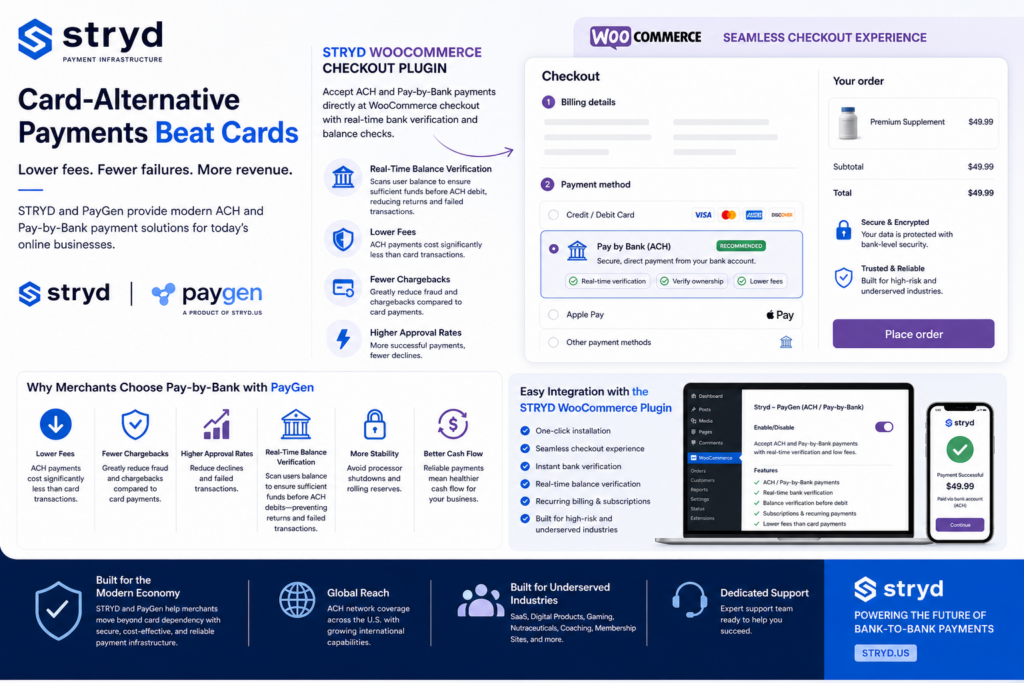
For years, credit and debit cards dominated online payments. They were fast, convenient, and widely accepted. But today, a major shift is happening across eCommerce, SaaS, gaming, subscription businesses, and high-risk industries: merchants are increasingly moving toward card-alternative payments, especially Pay by Bank and ACH-based systems.

The reason is simple — cards are becoming expensive, unstable, and risky for many businesses.

Meanwhile, bank-to-bank payment systems are proving to be faster, more secure, and far more reliable for modern merchants.

Platforms like STRYD and its merchant-facing payment solution PayGen are helping businesses transition away from over-dependence on card networks by offering modern ACH and Pay-by-Bank infrastructure built for today’s internet economy.

The Problem With Traditional Card Payments

Card processing comes with several hidden challenges that most merchants eventually experience:

  • High transaction fees
  • Chargebacks and fraud
  • Sudden account freezes
  • Rolling reserves
  • Declined transactions
  • Processor instability for high-risk industries

For businesses operating in industries like SaaS, nutraceuticals, coaching, peptides, gaming, travel, or digital products, traditional card processors often create more problems than solutions.

Many merchants discover that even legitimate businesses can suddenly lose payment access because banks and card networks classify them as “high risk.”

At the same time, card fraud continues to rise globally, forcing processors to tighten risk controls and increase reserve requirements.

Why Pay-by-Bank Is Growing Fast

Pay-by-Bank allows customers to pay directly from their bank accounts instead of using a card.

Rather than routing payments through Visa or Mastercard rails, the transaction moves through ACH banking infrastructure.

This creates several major advantages:

Lower Processing Costs

ACH and bank payments typically cost merchants significantly less than card transactions. Many businesses save thousands of dollars monthly by reducing card dependency.

Reduced Chargebacks

Unlike cards, ACH transactions generally experience fewer chargeback disputes, which reduces fraud exposure and operational losses.

Better Approval Rates

Card payments fail for many reasons:

  • Expired cards
  • Insufficient limits
  • Fraud filters
  • International restrictions

Bank payments eliminate many of these issues because they connect directly to verified bank accounts.

Real-Time Bank Verification

Modern Pay-by-Bank systems now use open banking and real-time account verification technologies to verify ownership and confirm available balances before processing payments.

This is where platforms like STRYD stand out.

According to the company’s published infrastructure overview, STRYD uses Plaid-powered bank verification and real-time balance checks to help merchants reduce failed ACH debits and payment returns.

How STRYD and PayGen Are Changing Payment Processing

PayGen is a merchant payment solution built on top of STRYD’s ACH and Pay-by-Bank infrastructure.

Instead of relying only on traditional card rails, Stryd gives merchants access to:

  • ACH / Pay-by-Bank payments
  • Real-time balance verification
  • Bank account authentication
  • Fraud screening
  • AI-powered risk analysis
  • WooCommerce integration
  • API-based payment infrastructure
  • Support for underserved industries

The system is especially useful for merchants that struggle with processor shutdowns or high chargeback environments.

STRYD states that its infrastructure was specifically designed to support industries often rejected by mainstream processors, including nutraceuticals, SaaS, gaming, digital products, and subscription businesses.

Consumers Are Already Comfortable With Bank Payments

Many users already interact with ACH-powered systems daily without realizing it.

Payroll deposits, subscription billing, bank transfers, peer-to-peer apps, and many fintech platforms rely heavily on ACH infrastructure. Community discussions across fintech and banking forums frequently point out that services like Venmo, bank transfer apps, and business payment systems already use ACH rails behind the scenes.

This means consumers are increasingly comfortable linking bank accounts directly for payments — especially when the checkout experience is instant and secure.

The Future of Payments Is Bank-to-Bank

Cards are not disappearing anytime soon. But the market is clearly evolving toward hybrid payment ecosystems where merchants offer both cards and direct bank payments.

The businesses adapting early are gaining advantages through:

  • Lower fees
  • Higher approval rates
  • Better stability
  • Reduced fraud exposure
  • Improved cash flow

As open banking adoption grows globally, Pay-by-Bank is expected to become one of the most important payment methods in eCommerce and digital business.

Platforms like STRYD and PayGen are positioning themselves at the center of that transition by helping merchants move beyond traditional card dependency and into the next generation of payment infrastructure.

WooCommerce Checkout

STRYD also offers a dedicated WooCommerce checkout plugin that allows merchants to integrate ACH and Pay-by-Bank payments directly into their store checkout flow without requiring complex custom development.

The plugin enables merchants to:

  • Accept ACH and Pay-by-Bank payments directly at checkout
  • Verify customer bank accounts instantly
  • Perform real-time balance verification before ACH debits
  • Reduce failed payments and insufficient-fund returns
  • Offer alternative payment methods alongside cards
  • Create smoother subscription and recurring billing experiences

For WooCommerce merchants, this means customers can complete payments directly from their bank accounts through a modern checkout experience while merchants benefit from lower fees, fewer chargebacks, and more stable payment processing.

The integration is especially valuable for:

  • SaaS businesses
  • Subscription platforms
  • Digital services
  • Online coaching businesses
  • eCommerce stores
  • High-risk merchants seeking alternatives to traditional card processors

Instead of relying entirely on Visa or Mastercard rails, merchants can now add a bank-to-bank payment option directly inside their WooCommerce checkout using STRYD’s infrastructure powered through .

In the coming years, the question may no longer be:
“Do you accept cards?”

Instead, it may become:
“Why are you still relying on them alone?”